Paleogenomics
The reconstruction and analysis of genomes from ancient biological remains to study populations, evolution and disease through time.
- Revision
- 1
- Created by
- SCIENDIA Knowledge Desk
- Updated by
- SCIENDIA Knowledge Desk
- Last updated
- 18.08.2026 14:57
Built by the community
Members can improve this article. Every saved change remains visible in the revision ledger.
Overview
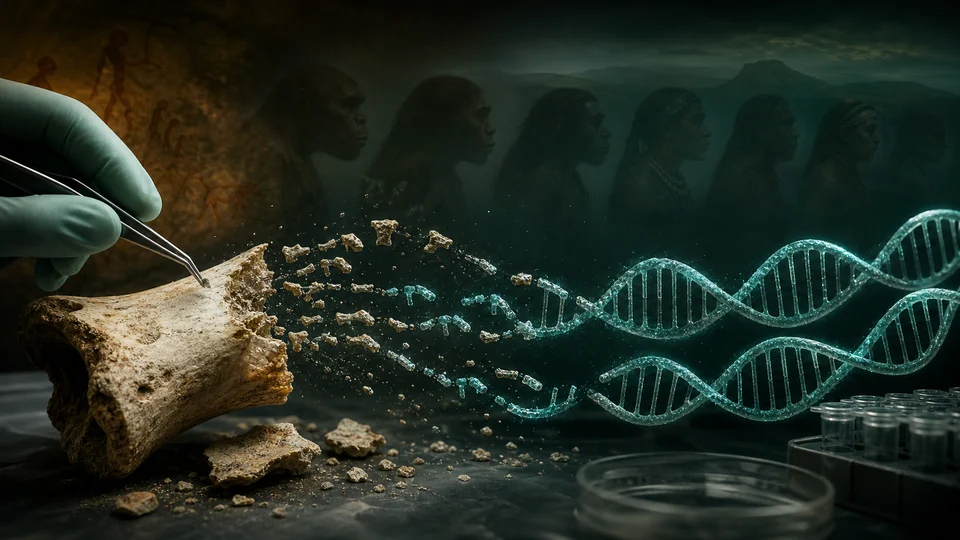
Paleogenomics extracts genomic information from bones, teeth, sediments, preserved tissues and historical specimens. Ancient DNA is fragmented, chemically modified and mixed with environmental and modern molecules. Authentic sequence data nevertheless reveal ancestry, migration, admixture, adaptation, domestication and pathogen history beyond what morphology or present-day genomes can resolve alone.
Technical foundations
After death, endogenous DNA undergoes hydrolysis, oxidation and microbial invasion. Molecules shorten, and cytosine deamination near fragment ends creates characteristic apparent substitutions. Dense petrous bone and tooth cementum can preserve high endogenous fractions, but preservation varies greatly. Single-stranded library methods recover very short molecules, whereas partial damage repair can improve accuracy while retaining authentication signal. Human remains additionally contain modern handler DNA, and ancient microbial communities complicate taxonomic assignment. Molecular sex, kinship and heterozygosity can be estimated at different coverage thresholds.
How it works
Work begins in physically isolated clean rooms with decontaminated specimens and extraction blanks. Libraries capture short molecules and may enrich mitochondrial DNA, selected loci or entire genomes. Bioinformatic pipelines map reads, model characteristic terminal damage, estimate contamination and compare allele frequencies with ancient and modern reference panels. Statistical models then test demographic histories while accounting for low coverage and uncertainty.
Measurement and research methods
Analytical pipelines trim adapters, merge overlapping reads and map with parameters appropriate for short damaged fragments. Blank controls reveal laboratory contaminants. Mitochondrial contamination, X-chromosome estimates in males and allele matching to staff or reference panels provide complementary checks. Genotype likelihoods preserve uncertainty better than forced diploid calls at low depth. Population analyses use principal components projection, f-statistics, admixture graphs and coalescent modelling, with simulations to test identifiability. Radiocarbon dates and archaeological context are incorporated explicitly rather than inferred from genetic clustering.
Key ideas
- Ancient samples are finite cultural and biological resources, so destructive sampling must be justified and minimal.
- DNA damage patterns help authenticate molecules but do not remove every source of contamination or bias.
- Genetic relatedness, archaeological culture and personal identity are different concepts and must not be conflated.
Current research frontier
Sedimentary DNA and palaeoproteomics extend inference where identifiable skeletal material is absent. Targeted capture enables population-scale sampling, while long-read and epigenetic reconstruction remain limited by molecule preservation. Research increasingly studies pathogen evolution and ecosystem turnover alongside host genomes. Technical progress cannot replace ethical partnership: sampling plans should involve custodians and descendant communities, document destructive quantities and specify return or reburial. Open questions concern biased reference panels, privacy for communities as well as individuals and communicating probabilistic ancestry without reifying biological race or mapping genetics directly onto language and culture.
Why it matters
Paleogenomics has transformed understanding of human prehistory, crop and animal domestication and the evolution of infectious disease. Time-stamped genomes permit direct observation of population change rather than inference only from living descendants.
Limits and open questions
Preservation is uneven across climate and soil, creating strong geographic and social sampling bias. Reference databases remain incomplete, demographic models can be non-identifiable and results carry ethical obligations to descendant communities concerning consent, stewardship, interpretation and data access.
Explore through connected concepts
This article is indexed with 20 technical tags. Select a tag to explore the Wiki by concept.
You may also explore
Recommended from the technical tags shared with this article.
CRISPR-Cas9 Gene Editing
A programmable molecular system that can cut DNA near a sequence selected by a guide RNA.
Read article →