Synthetic Biology
The design and construction of biological systems using engineering principles, quantitative models and molecular tools.
- Revision
- 1
- Created by
- SCIENDIA Knowledge Desk
- Updated by
- SCIENDIA Knowledge Desk
- Last updated
- 18.08.2026 10:51
Built by the community
Members can improve this article. Every saved change remains visible in the revision ledger.
Overview
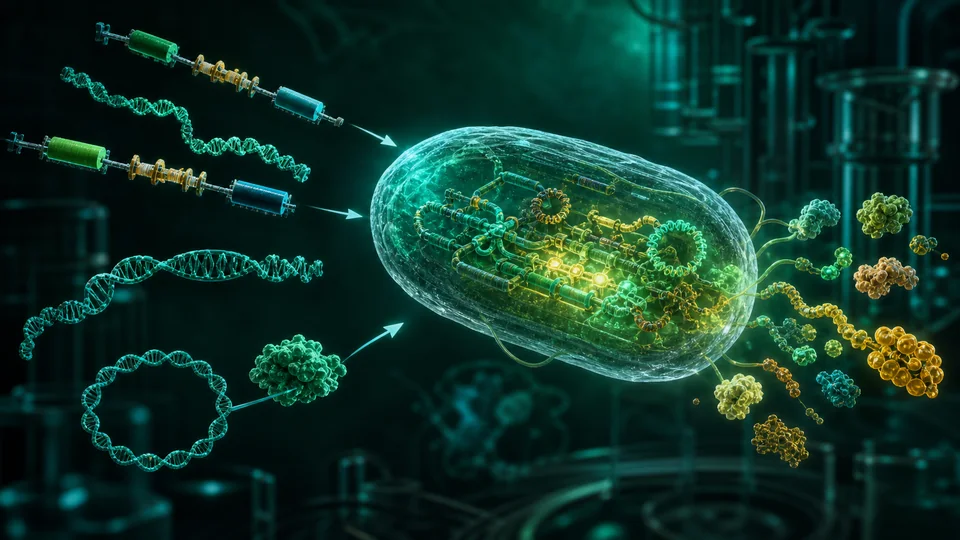
Synthetic biology seeks to make biological function more predictable by combining DNA assembly, genome editing, control theory, automation and systems biology. Researchers modify existing organisms or build cell-free systems to sense signals, compute responses, produce molecules or organise developmental programmes.
Technical foundations
Engineered gene circuits combine promoters, operators, untranslated regions, coding sequences and degradation signals to shape transcription and translation. Feedback can create switches, oscillators, filters or homeostatic control, but resource competition couples nominally separate modules through polymerases, ribosomes and metabolism. Host context influences copy number, growth and mutation. Genome-scale engineering modifies many loci or introduces synthetic chromosomes, while cell-free expression isolates biochemical machinery from replication. Quantitative models range from ordinary differential equations to stochastic and constraint-based formulations, each exposing different assumptions about kinetics and cellular resources.
How it works
A design-build-test-learn cycle begins with a functional specification and a host or biochemical chassis. Genetic parts are assembled into regulatory circuits, introduced into cells and measured under controlled conditions. Data are used to update mechanistic or statistical models before the next design round.
Measurement and research methods
The design-build-test-learn cycle increasingly uses automated liquid handling, standard data schemas and high-throughput sequencing. Libraries vary regulatory sequences or pathways, reporters quantify output and mass spectrometry measures products and intermediates. Controls separate construct effects from host and burden responses. Long-read sequencing verifies assemblies and detects rearrangement, while chemostats and serial passage test evolutionary stability. Model-guided design proposes candidates, but performance must be measured across environmental conditions and production scale. Biocontainment can use auxotrophy, kill switches, recoded genomes or dependency on synthetic metabolites, with escape frequency tested empirically.
Key ideas
- A genetic part does not have a fixed behaviour independent of host, burden and genomic context.
- Evolution can improve fitness while degrading an engineered function.
- Containment, traceability and failure-mode analysis belong in the design process from the start.
Current research frontier
Current research develops programmable cell therapies, living materials, minimal cells and engineered consortia that divide labour among strains. Metabolic engineering balances flux, toxicity and cofactor demand rather than maximising one enzyme in isolation. Artificial intelligence can propose proteins or regulatory sequences, but novelty, function and safety require experimental verification. Ecological applications demand models of dispersal, gene transfer and reversibility. Governance priorities include sequence screening, access controls, incident reporting and benefits shared with source communities. A robust design anticipates mutation, horizontal transfer, manufacturing variation and misuse as system properties rather than afterthoughts.
Why it matters
Applications include sustainable chemicals, engineered therapeutics, diagnostics, cultured materials and climate-relevant biomanufacturing. The discipline also tests fundamental ideas about cellular organisation and controllability.
Limits and open questions
Biological systems are noisy, adaptive and coupled across scales, so circuit behaviour often changes outside laboratory conditions. Biosafety, biosecurity, ecological effects, intellectual property and equitable access require governance alongside technical performance.
Explore through connected concepts
This article is indexed with 20 technical tags. Select a tag to explore the Wiki by concept.
You may also explore
Recommended from the technical tags shared with this article.
Microbial Synthetic Communities
Designed groups of microbial species used to study and engineer ecological interactions with controlled membership and function.
Read article →