CRISPR-Cas9 Gene Editing
A programmable molecular system that can cut DNA near a sequence selected by a guide RNA.
- Revision
- 2
- Created by
- SCIENDIA Knowledge Desk
- Updated by
- SCIENDIA Knowledge Desk
- Last updated
- 17.08.2026 18:43
Built by the community
Members can improve this article. Every saved change remains visible in the revision ledger.
Overview
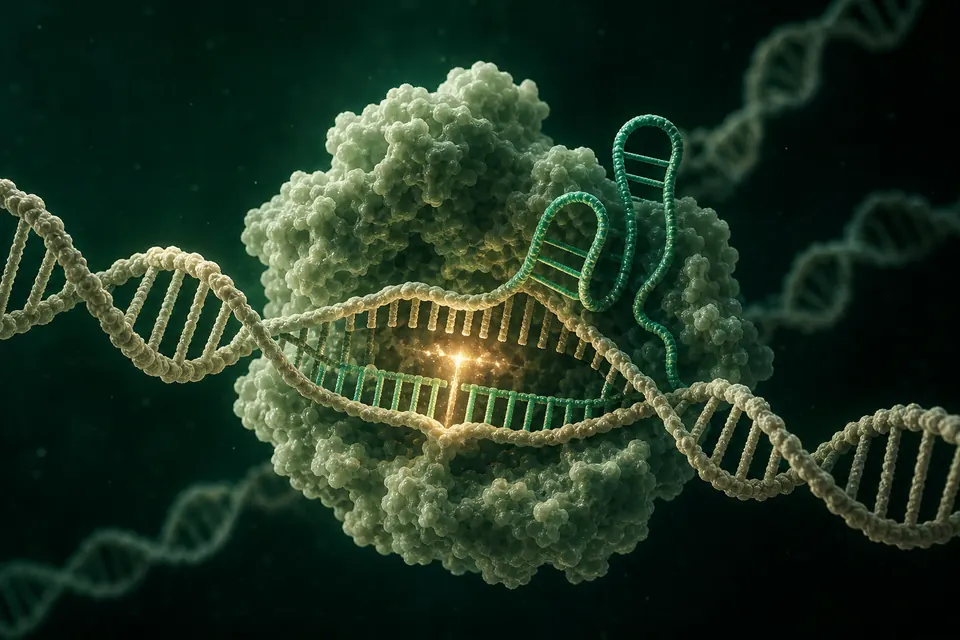
CRISPR-Cas9 is a genome-editing platform adapted from bacterial defence systems. A guide RNA directs the Cas9 nuclease to a complementary DNA sequence located beside a short recognition motif, allowing researchers to make a targeted double-strand break.
Technical foundations
Cas9 is an RNA-guided endonuclease whose HNH and RuvC catalytic domains cleave opposite DNA strands. Target recognition begins at a protospacer-adjacent motif, or PAM, and proceeds through formation of an RNA-DNA R-loop. Complementarity in the guide's PAM-proximal seed region is especially important, although tolerated mismatches depend on sequence and chromatin context. The resulting double-strand break is processed mainly by non-homologous end joining, microhomology-mediated end joining or homology-directed repair, producing a distribution of alleles rather than one guaranteed sequence outcome.
How it works
After Cas9 cuts the DNA, the cell repairs the break. End joining can introduce small insertions or deletions that disrupt a gene, while template-directed repair can install a designed sequence when an appropriate donor template and cellular conditions are available. Newer base and prime editors modify DNA without relying on the same type of double-strand break.
Measurement and research methods
Editing experiments are quantified by amplicon sequencing, long-read sequencing, digital PCR and, where appropriate, genome-wide assays for off-target cleavage or structural variation. Controls include an unedited sample, delivery-only controls and orthogonal guides aimed at the same locus. Guide design considers predicted specificity, nucleosome occupancy, transcript isoforms and population variants that may create or remove a target. Delivery can use ribonucleoprotein complexes, viral vectors, lipid nanoparticles or electroporation; each method changes exposure time, tissue reach, immune activation and the probability of persistent nuclease activity.
Key ideas
- Target choice is encoded largely by the guide-RNA sequence.
- Editing outcome depends on both the editor and the cell's repair pathways.
- Delivery, specificity and tissue context are central parts of experimental design.
Current research frontier
The technical frontier extends beyond nuclease-induced breaks. Cytosine and adenine base editors perform selected transitions, while prime editors use a reverse-transcription template encoded in an extended guide RNA to write small substitutions, insertions or deletions. Researchers are improving compact nucleases, tissue-selective delivery and transient expression to reduce unintended effects. Major unresolved issues include editing quiescent cells, detecting rare chromosomal rearrangements, predicting repair outcomes across cell types and establishing clinically meaningful long-term surveillance. Germline applications additionally require ethical and governance analysis that cannot be resolved by molecular accuracy alone.
Why it matters
The technology accelerates functional genomics, crop research, disease modelling and the development of some gene and cell therapies. Its programmability has made targeted genome manipulation accessible to many laboratories.
Limits and open questions
Off-target changes, incomplete editing, mosaic outcomes and delivery constraints can limit performance. Heritable human genome editing also raises major ethical and governance questions that are distinct from somatic treatments.
Explore through connected concepts
This article is indexed with 20 technical tags. Select a tag to explore the Wiki by concept.
You may also explore
Recommended from the technical tags shared with this article.
mRNA Therapeutics
Medicines that deliver engineered messenger RNA so cells transiently produce a therapeutic protein or antigen.
Read article →