Formal Verification
Mathematical methods for proving that hardware, software or protocols satisfy precisely stated properties under explicit assumptions.
- Revision
- 1
- Created by
- SCIENDIA Knowledge Desk
- Updated by
- SCIENDIA Knowledge Desk
- Last updated
- 19.08.2026 09:05
Built by the community
Members can improve this article. Every saved change remains visible in the revision ledger.
Overview
Formal verification replaces selected testing questions with logical proof. A system is represented in a mathematical language and checked against properties such as absence of deadlock, memory safety, functional correctness or security invariants. Proof establishes a statement about the model and assumptions; it does not guarantee that the specification captures every real-world requirement.
Technical foundations
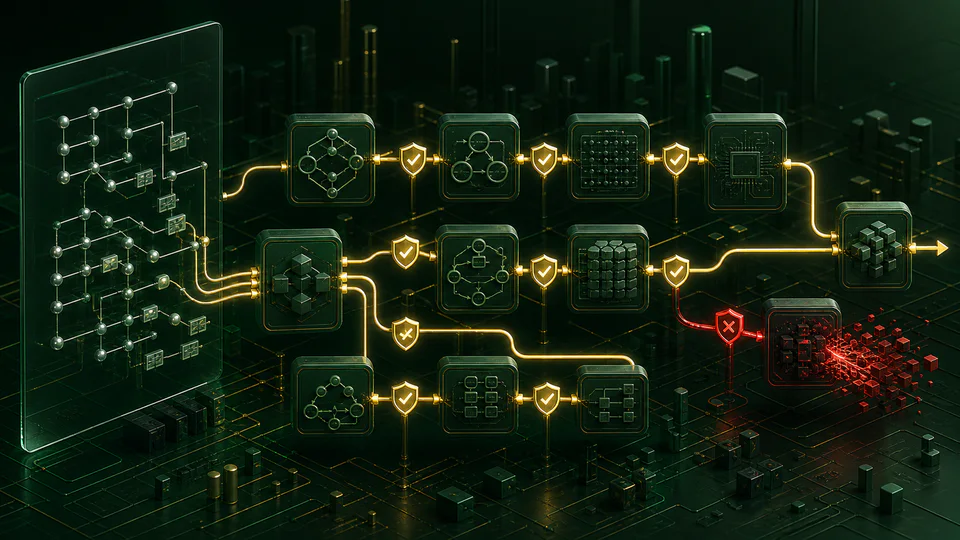
A transition system formalises states, inputs and allowed next states. Temporal logics express safety properties, stating that something bad never occurs, and liveness properties, stating that something good eventually occurs. Model checking searches for a counterexample trace. Hoare logic relates preconditions, programs and postconditions, and dependent types can encode rich invariants in type checking. Refinement proves that a concrete implementation simulates an abstract specification. The trusted computing base includes proof checkers, semantics and any unverified extraction or compiler steps.
How it works
Model checking explores a finite or symbolically represented state space, while theorem proving constructs deductive arguments with human guidance or automation. Satisfiability solvers decide logical constraints generated from programs, circuits and protocols. Abstract interpretation computes sound approximations of program behaviour. Refinement methods connect high-level specifications to executable implementations through a chain of proven-preserving steps.
Measurement and research methods
Verification projects define threats and system boundaries before choosing tools. Engineers annotate code with contracts, generate verification conditions and discharge them using SMT solvers or interactive proofs. Counterexamples are replayed as tests and specifications are reviewed against requirements. For concurrent systems, partial-order reduction and compositional reasoning control state growth. Continuous integration rechecks proofs after changes. Validation also compares the formal semantics with compiler and hardware behaviour, especially for undefined language features, relaxed memory and floating-point arithmetic.
Key ideas
- Verification is only as meaningful as the property, environmental assumptions and implementation boundary being verified.
- Sound abstraction may report false alarms, whereas unsound shortcuts can miss real failures.
- Proof artifacts and trusted checking kernels can make verification independently auditable.
Current research frontier
Automation increasingly combines invariant synthesis, symbolic execution and proof-guided program repair. Verified compilers and operating-system kernels show that large artifacts are possible, while proof-carrying code shifts checking to the consumer. Security protocols are analysed with computational and symbolic models. Current challenges include usable verification for distributed cloud systems, probabilistic and machine-learned components, and proof maintenance across evolving dependencies. Generated invariants from AI tools may speed authoring, but only a sound checker and a reviewed specification can provide assurance.
Why it matters
Formal methods are especially valuable for processors, cryptography, compilers, aerospace control and infrastructure where rare failures are costly. They can discover entire classes of corner cases that random tests are unlikely to reach and clarify ambiguous requirements before deployment.
Limits and open questions
State explosion, concurrency, floating-point arithmetic and interaction with unverified libraries remain difficult. Proof development can require specialised expertise and substantial maintenance as code evolves. Hardware faults, social misuse and incorrect operational assumptions lie outside many models, so verification complements rather than replaces testing, monitoring and governance.
Explore through connected concepts
This article is indexed with 20 technical tags. Select a tag to explore the Wiki by concept.
You may also explore
Recommended from the technical tags shared with this article.
Blockchain Consensus
How distributed participants agree on an ordered ledger despite delays, failures and conflicting proposals.
Read article →