Protein Folding
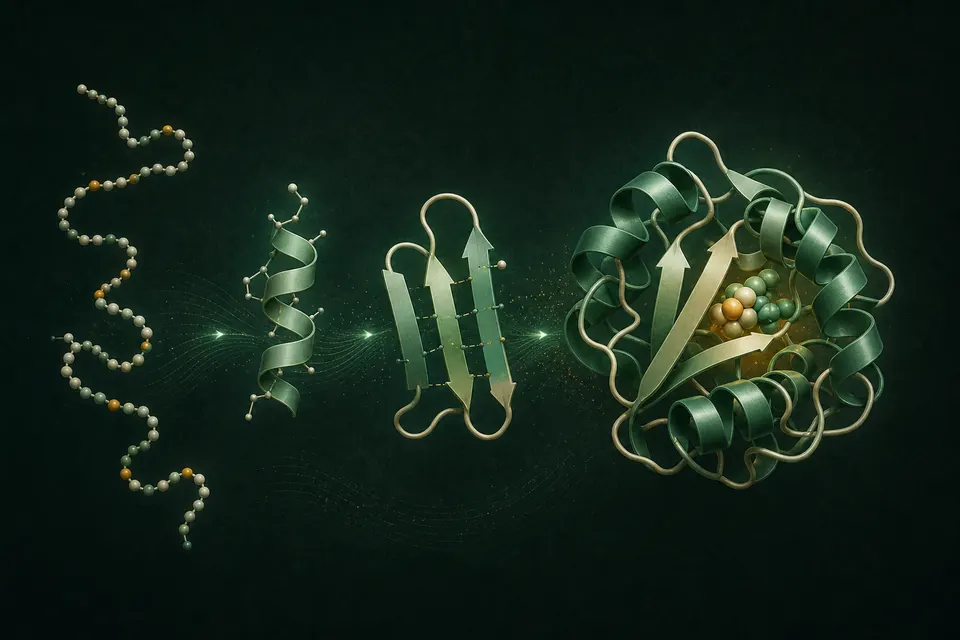
The process by which an amino-acid chain acquires the three-dimensional structure needed for biological function.
- Revision
- 2
- Created by
- SCIENDIA Knowledge Desk
- Updated by
- SCIENDIA Knowledge Desk
- Last updated
- 17.08.2026 18:43
Built by the community
Members can improve this article. Every saved change remains visible in the revision ledger.
Overview
A protein begins as a linear polymer but usually functions as a structured ensemble of three-dimensional conformations. Its sequence shapes a complex energy landscape in which hydrophobic effects, hydrogen bonds, electrostatics and molecular packing all contribute.
Technical foundations
Protein folding is governed by a high-dimensional free-energy landscape rather than a search through all possible conformations. Hydrophobic burial, backbone hydrogen bonding, electrostatics, van der Waals packing and solvent entropy contribute with context-dependent strengths. The native ensemble is usually a thermodynamic basin, while transition states and intermediates determine kinetics. Secondary-structure propensities are local, but tertiary packing and long-range contacts stabilise the final topology. Intrinsically disordered proteins instead retain broad ensembles and often fold only upon binding or environmental change.
How it works
Local helices and sheets can form while longer-range contacts bring distant residues together. Many small proteins fold spontaneously, whereas cells also use chaperones and quality-control systems to reduce aggregation and manage difficult folding pathways.
Measurement and research methods
Experimental structure methods provide different observables. X-ray crystallography infers electron density from diffraction, cryogenic electron microscopy reconstructs particle projections, and nuclear magnetic resonance measures constraints in solution. Circular dichroism, fluorescence, hydrogen-deuterium exchange and single-molecule force spectroscopy follow folding kinetics or stability. Computational prediction uses evolutionary covariation, learned structural priors and molecular simulation. Validation requires stereochemical checks, agreement with deposited density or restraints, and caution where confidence is low, alternate conformations exist or a crystallisation condition perturbs the native state.
Key ideas
- A protein is dynamic and occupies an ensemble, not one perfectly rigid shape.
- Sequence contains substantial structural information, but cellular context still matters.
- Misfolding and aggregation are related phenomena but are not identical.
Current research frontier
Cells regulate proteostasis through ribosome-associated folding, molecular chaperones, trafficking, degradation and stress responses. Mutations can destabilise a native state, accelerate aggregation or disrupt an interaction without changing the global fold. Current research integrates structure prediction with ligand binding, conformational dynamics and protein-complex assembly. Generative design can propose new sequences, but experimental testing remains necessary for solubility, specificity and function. Open problems include modelling post-translational modifications, membrane environments and crowded cytoplasm, as well as predicting kinetic traps and rare misfolded species linked to disease.
Why it matters
Structure helps explain enzyme activity, signalling, molecular recognition and the effects of genetic variants. Experimental and computational structure prediction accelerates biological discovery and drug design.
Limits and open questions
Predicting a stable structure does not automatically reveal function, kinetics or interactions in a cell. Intrinsically disordered regions and multi-protein assemblies also challenge a simple one-sequence, one-shape picture.
Explore through connected concepts
This article is indexed with 20 technical tags. Select a tag to explore the Wiki by concept.
You may also explore
Recommended from the technical tags shared with this article.
Computational Protein Design
The algorithmic creation of amino-acid sequences expected to fold into structures with specified biochemical functions.
Read article →