Ribosome Translation
The molecular decoding of messenger RNA into an ordered amino-acid chain by ribosomes and transfer RNAs.
- Revision
- 1
- Created by
- SCIENDIA Knowledge Desk
- Updated by
- SCIENDIA Knowledge Desk
- Last updated
- 18.08.2026 11:45
Built by the community
Members can improve this article. Every saved change remains visible in the revision ledger.
Overview
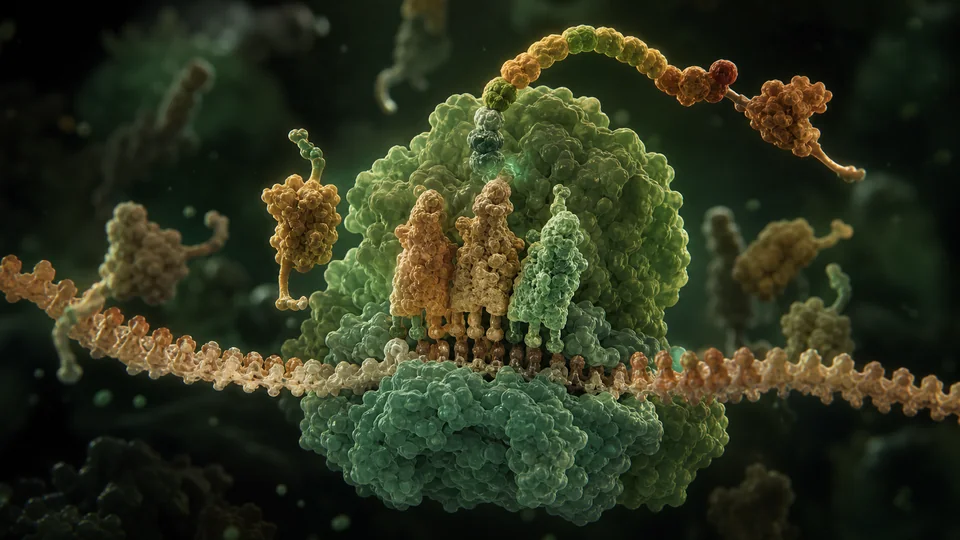
Translation converts nucleotide information into protein. A ribosome binds messenger RNA, selects transfer RNAs whose anticodons match successive codons and catalyses peptide-bond formation. The emerging polypeptide begins folding and may be directed toward cellular compartments while synthesis is still underway.
Technical foundations
The ribosome contains a small subunit that decodes messenger RNA and a large subunit whose ribosomal RNA catalyses peptide-bond formation. Aminoacyl-transfer-RNA synthetases charge transfer RNAs and provide a first specificity checkpoint. During elongation, delivery factors escort aminoacyl transfer RNA to the A site; correct codon pairing triggers accommodation, peptidyl transfer moves the growing chain from the P-site transfer RNA, and translocation advances messenger RNA. Guanosine-triphosphate hydrolysis makes selection and movement directional, while proofreading rejects many near-cognate substrates before irreversible incorporation.
How it works
Initiation positions a start codon and initiator transfer RNA in the ribosome. During elongation, aminoacyl transfer RNAs enter, decoding is checked, the peptide is transferred and the ribosome translocates by one codon. Stop codons recruit release factors rather than transfer RNAs, leading to hydrolysis and recycling of the translation machinery.
Measurement and research methods
Ribosome profiling sequences protected messenger-RNA fragments to infer ribosome positions, but nuclease bias, drug pretreatment and footprint assignment can distort occupancy. Pulse labelling and mass spectrometry measure protein output; single-molecule fluorescence resolves conformational kinetics; cryogenic electron microscopy captures structural intermediates. Reporter constructs test codon context, frameshifting and upstream open reading frames. Translation efficiency must distinguish initiation rate from ribosome density because slow elongation can raise occupancy without increasing production. Controls for messenger-RNA abundance and degradation are essential when connecting ribosome measurements to protein synthesis.
Key ideas
- Codon recognition is accurate but not perfectly deterministic and depends on kinetic proofreading.
- Translation rate is coupled to RNA structure, transfer-RNA availability and protein folding.
- Ribosomes are catalytic ribonucleoprotein machines rather than protein-only enzymes.
Current research frontier
Research examines how ribosome collisions activate quality control, how synonymous codons alter co-translational folding and how specialised ribosome composition affects selected transcripts. Expanded genetic codes introduce noncanonical amino acids through engineered synthetases and transfer RNAs, while orthogonal ribosomes isolate synthetic translation from cellular machinery. Therapeutic studies target nonsense suppression, ribosomal diseases and pathogen-specific translation. Open challenges include mapping translation in subcellular compartments, predicting nascent-chain interactions in real time and resolving whether apparent ribosome specialisation is causal or a secondary consequence of cell state.
Why it matters
Translation is essential to development, adaptation and biotechnology. Antibiotics, toxins and many diseases act through this machinery, while engineered translation systems enable recombinant proteins and expanded genetic codes.
Limits and open questions
A consensus codon table hides context-dependent recoding, RNA modifications and quality-control pathways. Measurements from bulk cells can miss ribosome collisions, local translation and cell-to-cell heterogeneity, and structural snapshots do not alone reveal kinetic flux.
Explore through connected concepts
This article is indexed with 20 technical tags. Select a tag to explore the Wiki by concept.
You may also explore
Recommended from the technical tags shared with this article.
mRNA Therapeutics
Medicines that deliver engineered messenger RNA so cells transiently produce a therapeutic protein or antigen.
Read article →