Messenger RNA Vaccines
Vaccines that deliver temporary genetic instructions so cells produce an antigen and train adaptive immunity.
- Revision
- 2
- Created by
- SCIENDIA Knowledge Desk
- Updated by
- SCIENDIA Knowledge Desk
- Last updated
- 17.08.2026 18:43
Built by the community
Members can improve this article. Every saved change remains visible in the revision ledger.
Overview
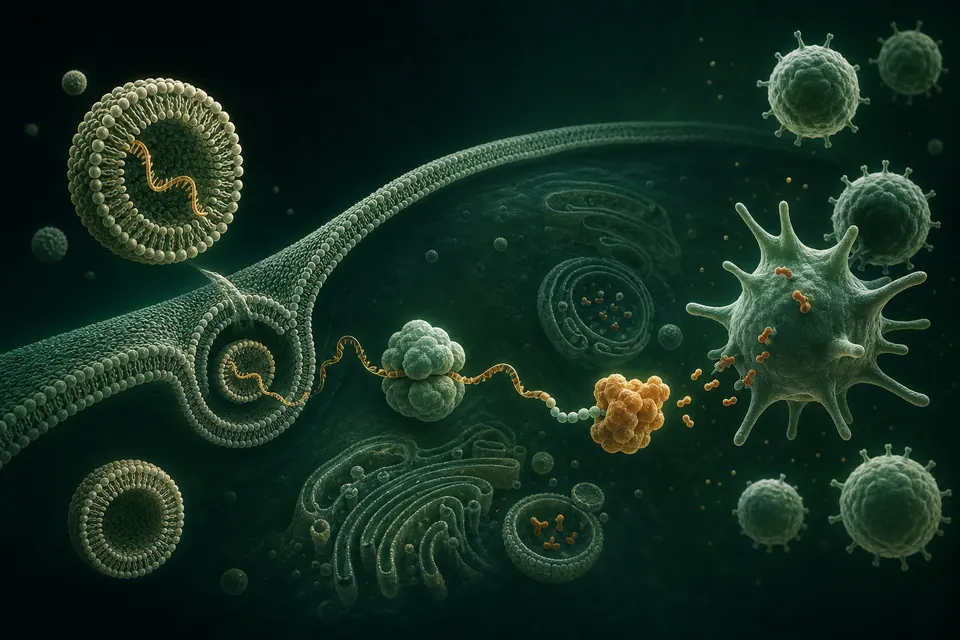
Messenger RNA vaccines provide a designed RNA sequence encoding an antigen. The RNA does not need to enter the cell nucleus; cellular ribosomes read it in the cytoplasm and produce the antigen for a limited period.
Technical foundations
An mRNA vaccine construct typically contains a cap structure, untranslated regions, an antigen-coding open reading frame and a polyadenylate tail. Sequence optimisation balances translation efficiency, RNA stability and innate sensing; modified nucleosides can reduce excessive recognition while preserving immunogenicity. Lipid nanoparticles encapsulate the negatively charged RNA, promote cellular uptake and support endosomal escape. After cytoplasmic translation, antigen is processed for major histocompatibility complex presentation, enabling CD4 T-cell help, cytotoxic T-cell responses and affinity-matured antibody production.
How it works
Lipid nanoparticles protect the RNA and help it enter cells. Antigen production and innate immune sensing activate antigen-presenting cells, which support antibody and T-cell responses. The RNA is then degraded through normal cellular processes.
Measurement and research methods
Development is evaluated through analytical chemistry, cell-based expression assays, animal studies and phased clinical trials. Potency assays test whether a batch delivers functional RNA rather than measuring sequence concentration alone. Trials estimate efficacy or immunogenicity with predefined endpoints and monitor common and rare adverse events; post-authorisation surveillance extends detection to much larger populations. Neutralisation assays, binding-antibody measurements and T-cell assays are related but not interchangeable correlates. Cold-chain requirements arise from hydrolysis, oxidation and particle stability and are formulation-specific.
Key ideas
- The delivered RNA is temporary and does not alter chromosomal DNA.
- Sequence design, chemical modification and delivery formulation all influence performance.
- Immune memory develops through cellular responses, not because the vaccine remains permanently.
Current research frontier
Platform research explores self-amplifying RNA, circular RNA, alternative ionisable lipids and tissue-selective nanoparticles. Cancer vaccines can encode patient-specific neoantigens, creating manufacturing and regulatory workflows different from mass prophylactic vaccines. Updating a sequence may be rapid, but antigen choice, production validation and clinical evidence remain necessary. Technical challenges include consistent endosomal escape, repeat dosing, inflammatory reactogenicity and delivery beyond liver or immune-rich tissues. Protection also depends on pathogen evolution and host immunity, so effectiveness is a property of a product, population, schedule and circulating variant rather than the platform alone.
Why it matters
The platform can be designed and manufactured rapidly once a target antigen is selected. It has expanded vaccine technology and is also being investigated for personalised cancer immunotherapy and other applications.
Limits and open questions
Stability, storage, reactogenicity, delivery to selected tissues and the durability of protection vary by product and target. Immune escape and pathogen evolution can require updated antigen designs.
Explore through connected concepts
This article is indexed with 20 technical tags. Select a tag to explore the Wiki by concept.
You may also explore
Recommended from the technical tags shared with this article.
mRNA Therapeutics
Medicines that deliver engineered messenger RNA so cells transiently produce a therapeutic protein or antigen.
Read article →