Immunometabolism
The reciprocal control between cellular metabolic pathways and the activation, differentiation and function of immune cells.
- Revision
- 1
- Created by
- SCIENDIA Knowledge Desk
- Updated by
- SCIENDIA Knowledge Desk
- Last updated
- 18.08.2026 14:57
Built by the community
Members can improve this article. Every saved change remains visible in the revision ledger.
Overview
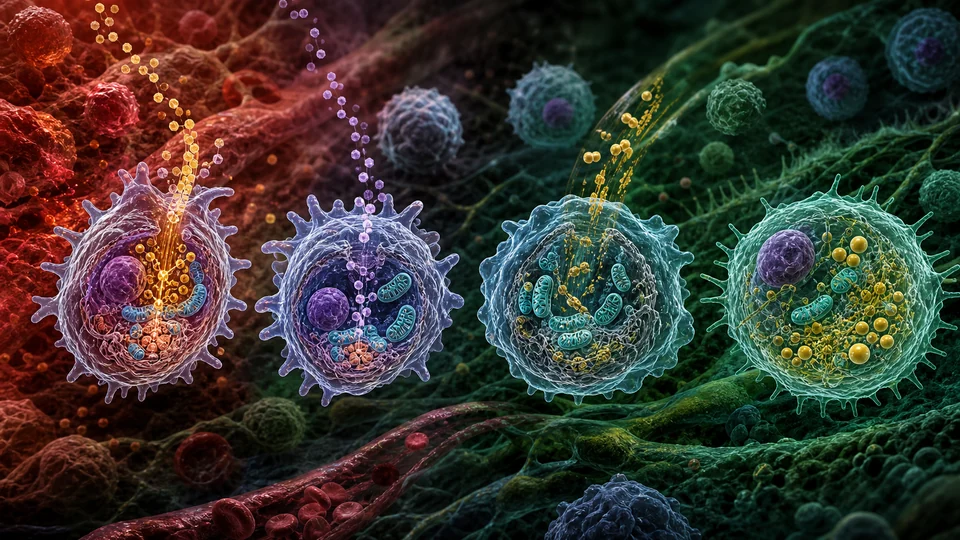
Immune cells remodel nutrient use when they activate, migrate or enter tissues. Glycolysis, mitochondrial respiration, amino-acid pathways and lipid metabolism provide more than ATP: their intermediates alter signalling, redox balance, chromatin and biosynthesis. Conversely, cytokines and antigen receptors change transporter expression and enzyme activity, coupling metabolic state to immune fate.
Technical foundations
Immune activation changes uptake of glucose, glutamine, fatty acids and amino acids through regulators including mTOR, AMPK, HIF and MYC. Rapid glycolysis can supply intermediates for nucleotides and lipids even when oxygen is available. Mitochondria provide ATP, reactive oxygen signals and metabolites such as citrate, succinate and alpha-ketoglutarate that influence inflammatory transcription and chromatin enzymes. T cells, macrophages and innate lymphoid cells use these modules differently across effector, memory and regulatory states.
How it works
Receptor signalling activates transcriptional and kinase programmes that redirect carbon and nitrogen flux. Stable-isotope tracers follow nutrients through pathways, extracellular flux assays estimate respiration and acidification, and mass spectrometry measures metabolites. Single-cell and spatial methods reveal heterogeneity across tissue niches, while genetic or pharmacological perturbations test whether a pathway is required for a specific function.
Measurement and research methods
Stable-isotope-resolved metabolomics distinguishes pathway flux from static concentration by tracing labelled atoms into downstream products. Extracellular flux instruments estimate oxygen consumption and proton efflux but require controls for cell number and non-glycolytic acidification. Genetic perturbation tests enzyme necessity, while rescue with downstream metabolites helps establish mechanism. Tissue imaging and spatial metabolomics map nutrient gradients. Experiments should use physiologic oxygen and nutrient levels because standard culture media contain supraphysiologic components that can reverse a metabolic phenotype.
Key ideas
- Metabolite abundance is a pool measurement and does not by itself reveal pathway flux.
- Immune metabolism differs between culture medium, blood, tumours and infected or nutrient-limited tissues.
- The same pathway can support inflammatory activity in one cell type and regulatory or repair functions in another.
Current research frontier
Cancer research studies competition for glucose and amino acids between tumour and immune cells, along with lactate, acidity and hypoxia that suppress function. In infection, host-directed metabolic therapy could strengthen defence without directly selecting microbial resistance, but may worsen tissue damage. The frontier includes organelle contact sites, trained innate immunity and microbiome-derived metabolites. Major challenges are cell-type specificity, timing and systemic toxicity. A pathway associated with activation may be compensatory rather than causal, so clinical biomarkers must demonstrate target engagement and improved immune function in the relevant tissue.
Why it matters
Immunometabolism links infection, autoimmunity, cancer and metabolic disease and suggests ways to reshape immunity through nutrient transport or enzyme targets. It can also explain why immune therapies work differently across tissue environments.
Limits and open questions
Systemic metabolic intervention affects many organs and may impair protective immunity. Common inhibitors have off-target effects, while ex-vivo measurements disturb nutrient conditions. Translation requires tissue-resolved biomarkers and causal studies that separate metabolic adaptation from the mechanism driving disease.
Explore through connected concepts
This article is indexed with 20 technical tags. Select a tag to explore the Wiki by concept.
You may also explore
Recommended from the technical tags shared with this article.
Autophagy
Cellular pathways that deliver cytoplasmic material to lysosomes or vacuoles for degradation, quality control and recycling.
Read article →