Swarm Intelligence
Collective problem-solving that emerges from local interactions among many comparatively simple autonomous agents.
- Revision
- 1
- Created by
- SCIENDIA Knowledge Desk
- Updated by
- SCIENDIA Knowledge Desk
- Last updated
- 18.08.2026 11:45
Built by the community
Members can improve this article. Every saved change remains visible in the revision ledger.
Overview
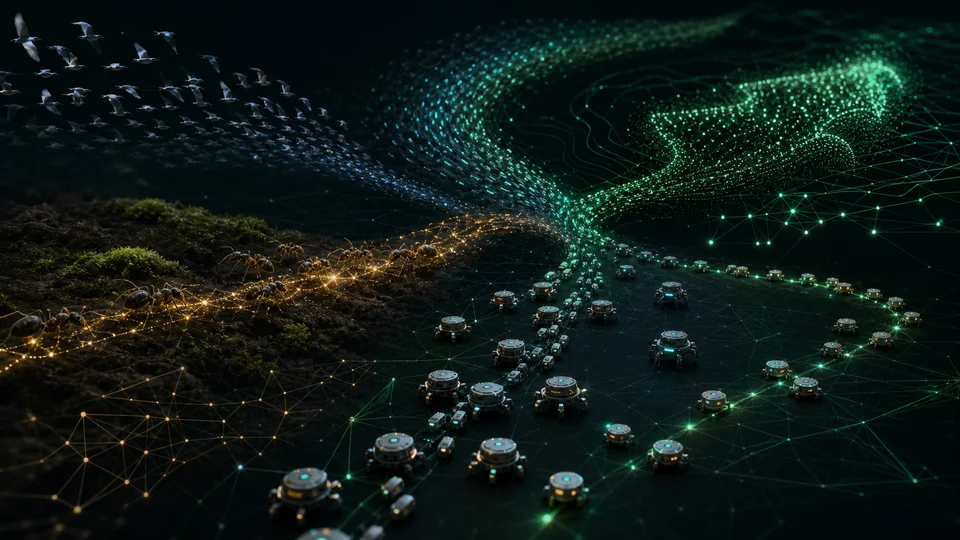
Swarm intelligence studies how decentralised agents can coordinate without a global controller. Social insects, flocking animals and distributed robots demonstrate how local sensing, communication and environmental traces produce collective search, allocation, transport or movement patterns.
Technical foundations
Swarm models use local interaction rules and distributed information. In flocking models, agents balance alignment, cohesion and collision avoidance; ant-colony optimisation reinforces paths with simulated pheromone while evaporation preserves exploration; particle-swarm optimisation updates candidates using personal and neighbourhood experience. Macroscopic behaviour can be studied through mean-field or continuum equations, but finite populations, network topology and delays alter stability. Symmetry breaking allows a group to choose among equivalent options, and quorum thresholds prevent weak signals from triggering premature commitment.
How it works
Agents follow limited rules such as alignment, separation, attraction, recruitment or reinforcement. Feedback amplifies useful discoveries, while evaporation, noise or inhibitory signals prevent premature lock-in. The system-level pattern emerges through repeated interaction and can adapt when agents or environmental conditions change.
Measurement and research methods
Evaluation measures solution quality, convergence time, energy, communication and resilience under agent loss or sensor error. Simulations should include latency, localisation uncertainty and collision dynamics before claims transfer to robots. Hardware experiments test decentralised control without a privileged global channel. Biological studies use trajectory tracking, perturbations and agent-level manipulation to distinguish mechanisms that generate similar patterns. Benchmarking must compare centralised and decentralised baselines under equal information and resource budgets; otherwise redundancy or parallel hardware can be mistaken for an algorithmic advantage.
Key ideas
- Emergent coordination does not imply that individual agents represent the global solution.
- Positive feedback needs balancing mechanisms to preserve exploration and stability.
- Robustness to agent loss can coexist with vulnerability to correlated misinformation.
Current research frontier
The frontier includes heterogeneous robot teams, adaptive communication graphs and human-swarm interaction. Applications cover warehouse movement, environmental monitoring, search and exploration where topology changes continuously. Learning local policies can improve performance but may reduce interpretability and introduce coordinated failure under distribution shift. Security research studies spoofed neighbours, compromised agents and false environmental traces. Open problems include formal guarantees for large physical swarms, safe recovery from fragmentation, ethically managing autonomous collective behaviour and designing simple local rules that remain effective when terrain, objectives and population size change unexpectedly.
Why it matters
Swarm principles support routing, scheduling, search, sensor networks and multi-robot exploration where central control is costly or fragile. Biological comparisons also reveal how collective decisions evolve and fail.
Limits and open questions
Many algorithms are demonstrated on simplified benchmarks with ideal communication. Physical swarms face delays, collisions, energy limits and adversarial signals, while mathematical convergence can require assumptions that real environments violate.
Explore through connected concepts
This article is indexed with 20 technical tags. Select a tag to explore the Wiki by concept.
You may also explore
Recommended from the technical tags shared with this article.
Artificial Neural Networks
Layered computational models that learn distributed representations by adjusting weighted connections from data.
Read article →