Protein Language Models
Machine-learning models that learn statistical representations of amino-acid sequences for prediction and molecular design.
- Revision
- 1
- Created by
- SCIENDIA Knowledge Desk
- Updated by
- SCIENDIA Knowledge Desk
- Last updated
- 18.08.2026 14:57
Built by the community
Members can improve this article. Every saved change remains visible in the revision ledger.
Overview
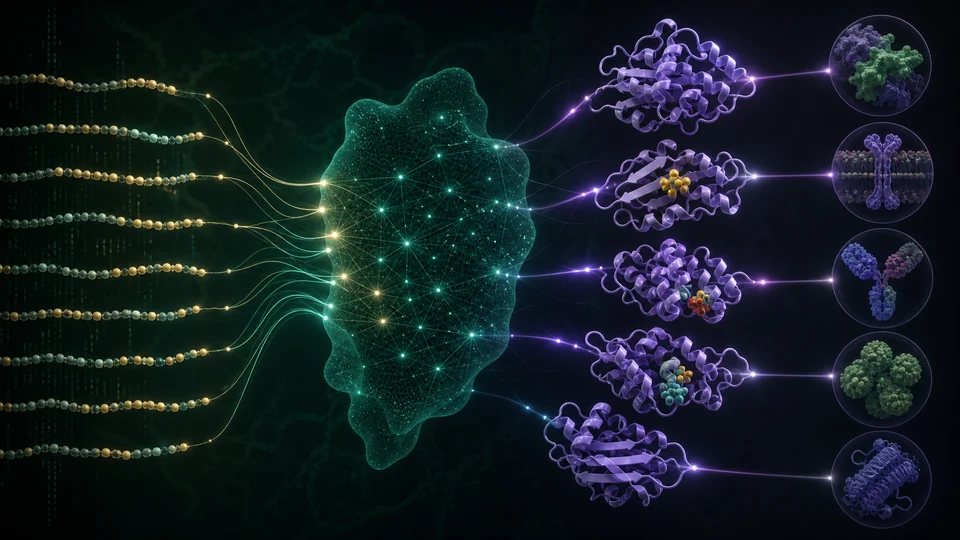
Protein language models treat amino-acid sequences as structured symbol strings shaped by evolution and biophysics. Training on large sequence databases produces representations that encode family relationships, structural constraints and sometimes functional signals. These models can support structure prediction, variant scoring, annotation, retrieval and generation of candidate proteins.
Technical foundations
A protein sequence model estimates conditional or joint distributions over amino acids. Masked models infer hidden residues from bidirectional context, autoregressive models generate from one direction and diffusion-like models iteratively denoise sequences or structures. Attention can capture long-range coevolutionary constraints, though it does not uniquely identify physical contacts. Embeddings from intermediate layers serve as features for secondary structure, localisation or fitness prediction. Structure-conditioned models incorporate backbone geometry, while multimodal systems connect sequence with text, function, interaction or experimental measurements.
How it works
Self-supervised objectives hide residues or predict sequence context, forcing a transformer or related architecture to model dependencies across positions. Embeddings are transferred to supervised tasks or decoded into new sequences. Design pipelines combine model likelihood with structural prediction, motif constraints and laboratory screening. Multiple-sequence alignments, taxonomic metadata and paired chains may supply additional evolutionary context.
Measurement and research methods
Evaluation must split data by sequence identity, structural fold or release date to prevent close homologues leaking across train and test sets. Variant-effect benchmarks compare rank correlation and calibration across proteins, not only aggregate accuracy dominated by easy families. Generated proteins are filtered for novelty, predicted folding, aggregation and motifs, then expressed and assayed prospectively. Negative results are essential for estimating hit rate. Database curation removes fragments, sequencing errors and problematic metadata, and model cards document training corpora, licences, compute and intended biosafety controls.
Key ideas
- A high model probability indicates consistency with training patterns, not guaranteed folding or biological function.
- Sequence databases are redundant and taxonomically biased, so evaluation splits must prevent family leakage.
- Wet-laboratory validation remains necessary because activity, expression, stability and safety are distinct properties.
Current research frontier
Research combines language representations with inverse folding, docking and active learning from automated laboratories. Retrieval can ground predictions in annotated homologues, while parameter-efficient adaptation targets specialised families. Models may help design enzymes with new stability or substrate profiles, but catalytic function depends on transition-state geometry and cellular context beyond fold. Open problems include calibrated uncertainty in remote sequence space, epistasis among multiple mutations and paired protein interactions. Governance is necessary because the same generative capacity can lower barriers to harmful design; tiered access and sequence screening complement, but do not replace, expert review.
Why it matters
The approach can prioritise experiments across enormous sequence spaces and reveal useful representations without hand-crafted features. It accelerates enzyme engineering, antibody research and interpretation of previously uncharacterised protein families.
Limits and open questions
Models may memorise common families, underperform on remote novelty and provide poorly calibrated confidence. Generated sequences can be difficult to manufacture or unsafe in context. Responsible pipelines need provenance, access controls, biosafety review and prospective experimental benchmarks rather than retrospective examples alone.
Explore through connected concepts
This article is indexed with 20 technical tags. Select a tag to explore the Wiki by concept.
You may also explore
Recommended from the technical tags shared with this article.

Artificial Neural Networks
Layered computational models that learn distributed representations by adjusting weighted connections from data.
Read article →