Single-Cell RNA Sequencing
Methods that measure transcript abundance in individual cells to resolve heterogeneous biological populations.
- Revision
- 1
- Created by
- SCIENDIA Knowledge Desk
- Updated by
- SCIENDIA Knowledge Desk
- Last updated
- 18.08.2026 10:51
Built by the community
Members can improve this article. Every saved change remains visible in the revision ledger.
Overview
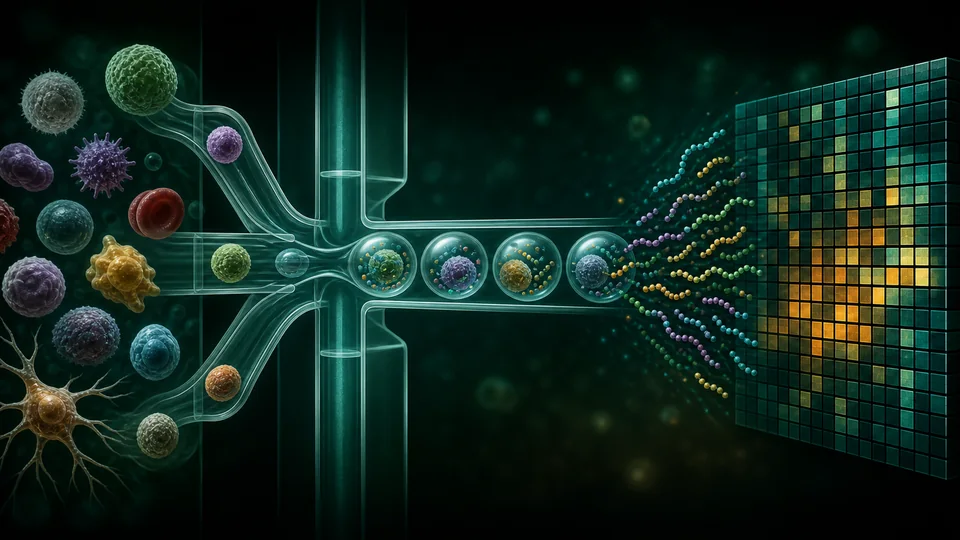
Single-cell RNA sequencing separates a tissue into individual cells or nuclei and records a sampled profile of RNA molecules from each one. Unlike bulk sequencing, which averages over many cells, the method can reveal rare populations, continuous developmental trajectories, transient responses and differences between cells that share a conventional anatomical label.
Technical foundations
The observed count for a gene in a cell is a stochastic sample shaped by transcript abundance, capture efficiency, reverse transcription, amplification and sequencing depth. Unique molecular identifiers reduce amplification bias by collapsing reads derived from one captured molecule. Droplet platforms scale to many cells but sample only a fraction of transcripts, whereas plate-based protocols can achieve greater sensitivity at lower throughput. Single-nucleus sequencing avoids difficult tissue dissociation and can recover archived or frozen material, but nuclear RNA composition differs systematically from whole-cell measurements and requires protocol-aware interpretation.
How it works
Cells are isolated in wells, droplets or microfluidic chambers. During reverse transcription, transcripts receive a cell barcode and usually a unique molecular identifier. After pooled library preparation and sequencing, reads are assigned back to cells and genes, producing a sparse count matrix that is filtered, normalised and analysed statistically.
Measurement and research methods
Computational workflows remove low-quality barcodes using library size, detected features and mitochondrial proportion, identify doublets and estimate ambient-RNA contamination. Normalisation and variance modelling precede dimensionality reduction, neighbour-graph construction and clustering. Differential-expression tests must treat biological replicates, rather than thousands of cells from one specimen, as the independent units when population inference is intended. Batch integration can align shared biology but may erase real condition-specific states. Marker-based annotation is strengthened by reference mapping, spatial assays, flow cytometry, perturbation experiments or lineage information.
Key ideas
- A measured zero may represent biological absence or failure to capture a transcript.
- Cell dissociation, ambient RNA and doublets can create systematic artefacts before sequencing begins.
- Cell types are inferred from multiple markers, experimental context and independent validation rather than one cluster label.
Current research frontier
The frontier combines transcriptomes with chromatin accessibility, surface proteins, lineage barcodes, perturbations and spatial coordinates in the same or matched cells. Trajectory and RNA-velocity methods estimate dynamic direction from snapshot data under assumptions about kinetics and sampling; they do not directly observe a lineage. Large atlases require hierarchical models that preserve donor variation and uncertainty. Privacy-aware analysis is important because expressed genetic variants may identify participants. Remaining challenges include absolute molecule calibration, rare-cell recovery, cross-study ontology alignment and mechanistic models that distinguish a regulatory transition from correlated shifts in cell cycle, stress or tissue processing.
Why it matters
The technology maps development, immunity, cancer and tissue organisation at cellular resolution. It supports disease atlases, target discovery and experiments that connect perturbations with cell-state changes.
Limits and open questions
RNA abundance is only one layer of cell state and does not directly measure protein activity, spatial position or lineage history. Cost, sampling bias, batch effects and ethical handling of donor-linked genomic information constrain study design and interpretation.
Explore through connected concepts
This article is indexed with 20 technical tags. Select a tag to explore the Wiki by concept.
You may also explore
Recommended from the technical tags shared with this article.
Spatial Transcriptomics
Methods that measure gene expression while preserving the locations and neighbourhoods of cells within tissue.
Read article →